Your Cart is Empty
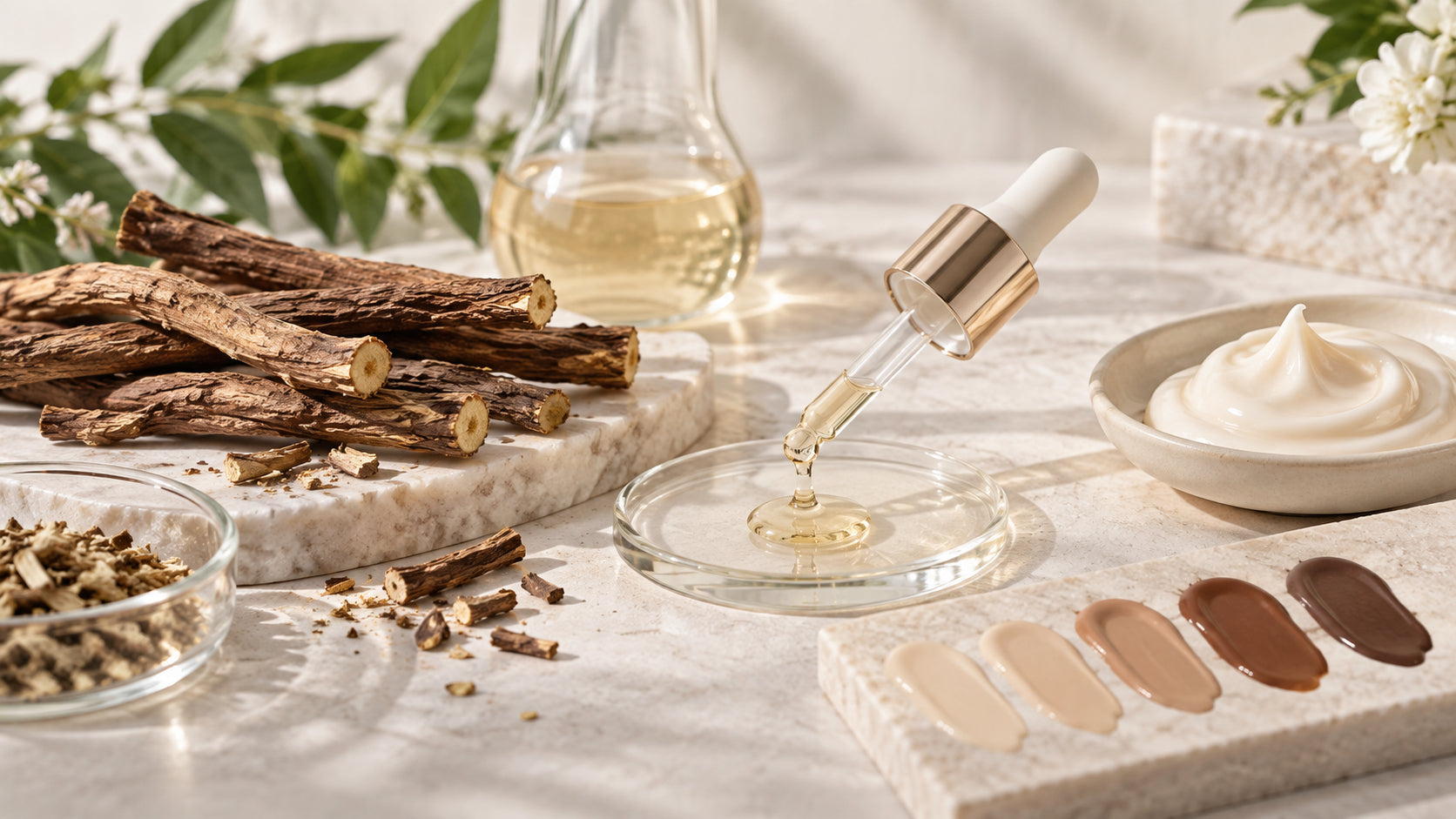
Licochalcone A is a licorice-derived chalcone studied in redness-oriented skincare. Research includes laboratory inflammatory pathways and human irritation models using specified formulas. It is a different compound from glabridin and cannot be assumed to occur at a standardized level in every product labeled licorice root extract.
Glycyrrhiza inflata is an important source in the published topical research. The botanical species and the way its extract is prepared matter: a general Glycyrrhiza glabra ingredient declaration does not establish the same licochalcone A content as a defined inflata preparation.
Glabridin is an isoflavan associated with much of the licorice pigment research; licochalcone A is a chalcone with its own evidence. The glabridin guide explains that distinction. A glycyrrhizate salt is another separate material.
Researchers have investigated oxidative stress and inflammatory signaling in cell systems. Inflammatory mediators measured in a laboratory are useful for exploring a mechanism. They are not a diagnosis, and changing a cell marker does not prove that an ordinary cream treats an inflammatory skin disease.
A 2006 study by Kolbe and colleagues used prospective randomized vehicle-controlled post-shaving and UV-induced erythema models. The tested licochalcone A formulations reduced redness compared with their vehicles in those settings. That provides more relevant topical evidence than cells alone, while remaining specific to the preparation and test conditions.
A controlled irritation model is different from daily facial skincare in every sensitive person. The UV model also does not demonstrate sunscreen protection or a safe alternative to SPF.
In a 2016 paper, one post-shave experiment tested licochalcone A-rich licorice extract with 4-t-butylcyclohexanol. Its redness findings belong to that combination. A separate rapid stinging experiment in the same paper tested 4-t-butylcyclohexanol; its immediate results should not be assigned to licochalcone A.
The authors were industry employees, and the tested preparations were specific. These factors do not erase the findings, but they help define what can be generalized. The paper does not certify every retail licorice product or prove that any two soothing ingredients are synergistic.
Ordinary cosmetics containing this ingredient are not substitutes for care of rosacea, eczema or dermatitis. Persistent redness, recurring flushing, soreness or a rash needs evaluation. The licorice redness guide translates the ingredient evidence into sensible selection, while the sensitive-skin guide covers the broader concern.
By Herbal Dynamics Beauty · Reviewed October 6, 2026.