Your Cart is Empty
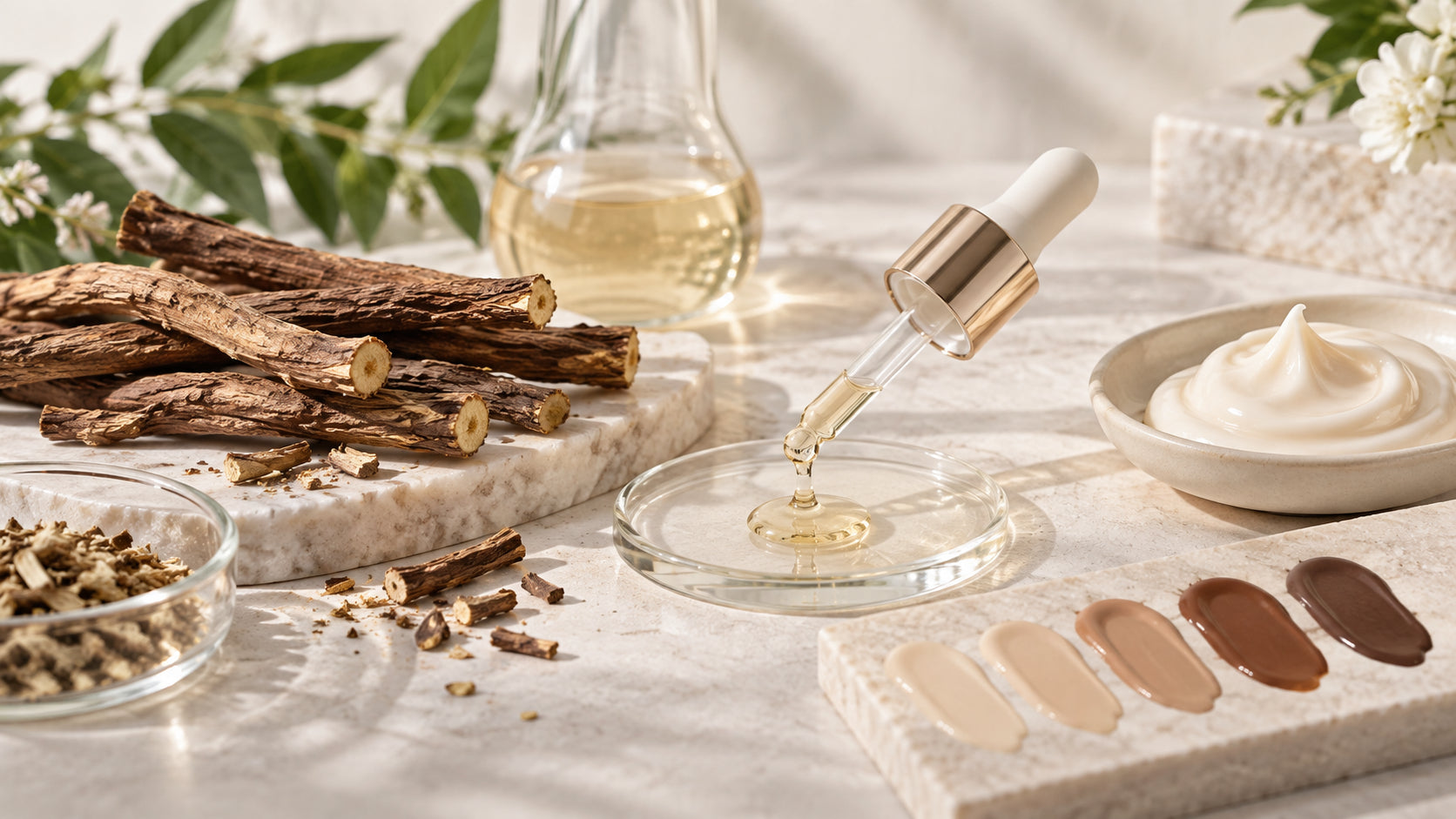
Glabridin is a licorice-derived isoflavan studied for pigmentation-related and antioxidant activity. It is associated especially with Glycyrrhiza glabra. Its research helps explain interest in licorice skincare, but it does not establish that every root-extract product contains a useful glabridin concentration or fades dark spots.
An extract is a mixture; glabridin is a particular molecule. Species, extraction and enrichment affect which compounds a material contains. The 2013 phytochemistry review describes glabridin’s chemistry and its role as a characteristic constituent of Glycyrrhiza glabra. A product using another licorice species should not automatically inherit the same composition.
Glabridin differs from licochalcone A, liquiritin and glycyrrhizin. The last two names are not alternate spellings for glabridin. This matters when a claim cites a study: the tested compound needs to match the ingredient being discussed.
Tyrosinase participates in melanin production. Yokota and colleagues’ 1998 study investigated glabridin in murine melanoma cells and guinea-pig skin, finding pigment-pathway and inflammation-related effects in those models. It was not a clinical facial-serum trial in people.
An enzyme or animal result can support a research hypothesis. It cannot tell you how much an ordinary cosmetic will change a particular dark spot. Application, skin delivery, the tested concentration and the rest of the formula all matter. The dark-spot guide places these mechanisms in a practical pigmentation routine.
Laboratory work also examines glabridin’s effects on reactive oxygen species and related cellular processes. These observations are different from demonstrating that a consumer product prevents visible aging or reverses sun damage. A formula’s antioxidant claim should be judged on relevant testing, stability and use conditions.
Glabridin is not a sunscreen filter. UV-related experiments do not assign SPF or UVA protection to a licorice serum. Keep broad-spectrum sunscreen and other sun-protection measures in place.
Glabridin is relatively hydrophobic, so incorporating it into a stable, usable topical preparation is a formulation question. “Natural delivery,” a watery serum or a premium bottle alone cannot answer it. Nor does a root-extract percentage automatically equal the percentage of glabridin in the finished product.
Check whether the maker identifies a standardized material, an actual glabridin specification and finished-product evidence. The concentration-label guide explains how to read those statements without guessing an ideal dose.
Consider it an optional ingredient in a well-formulated pigment-focused product. Introduce the complete formula according to its directions and your tolerance; do not apply raw glabridin powder or recreate a laboratory preparation. Continued irritation can work against an even-looking complexion. For results and timing questions, consult the human-evidence assessment.
By Herbal Dynamics Beauty · Reviewed October 6, 2026.