Your Cart is Empty

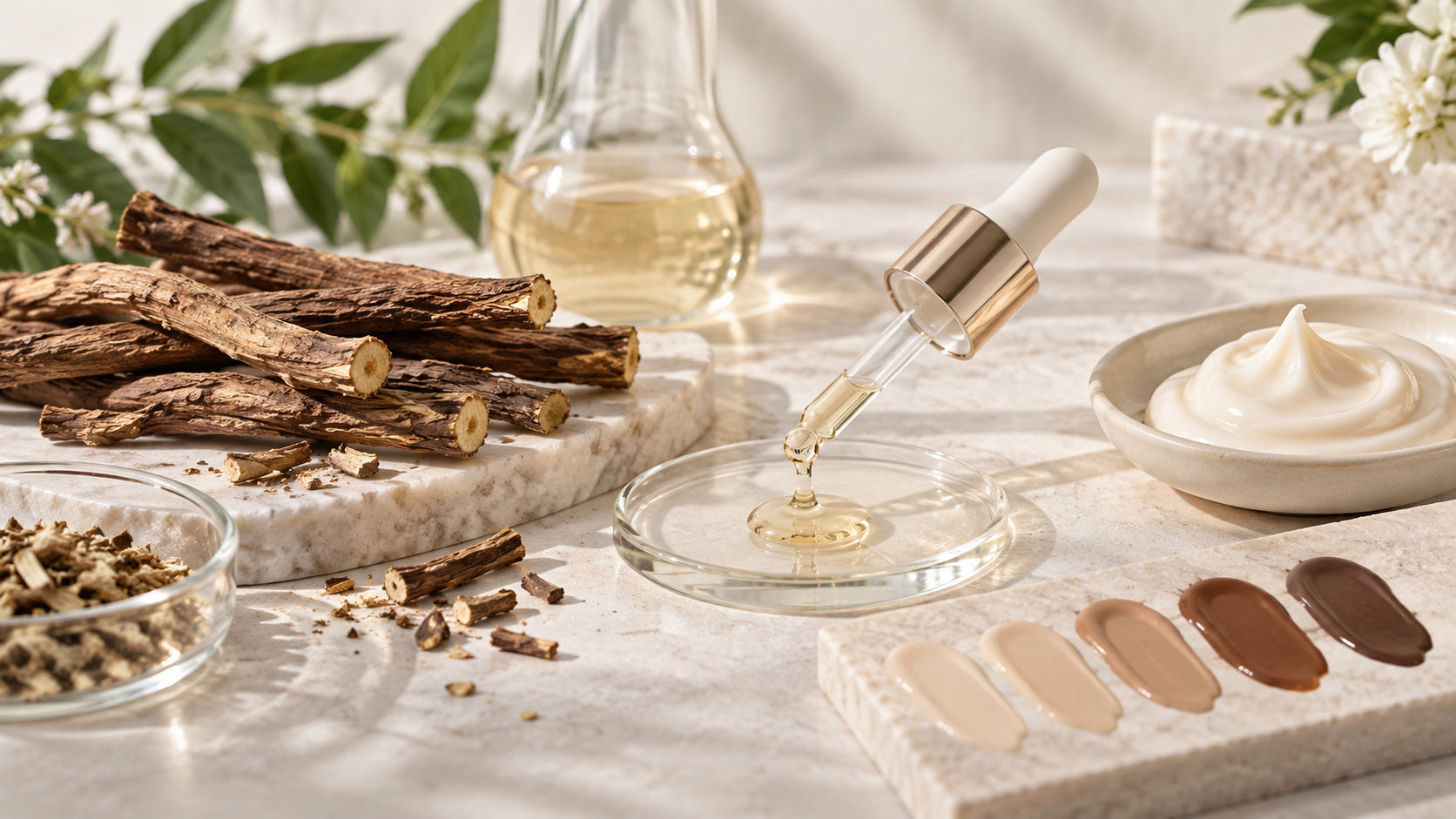
Licorice has credible topical research, but the answer depends on the compound, formula and outcome. Some human studies test defined liquiritin or licochalcone A preparations; much of the commonly cited glabridin pigmentation work is preclinical. Neither category establishes a universal result for every licorice serum.
| Research question | Evidence example | Main boundary |
|---|---|---|
| Pigment-pathway activity | Glabridin in cell and animal models | Not a human facial-product trial |
| Pigmentation in people | Small split-face liquiritin cream study in melasma | A specific compound, formula and diagnosed population |
| Induced redness in people | Vehicle-controlled licochalcone A irritation experiments | Defined irritation models and preparations |
| Comfort in a skincare routine | Licochalcone A regimen and combination studies | Other ingredients and steps can contribute |
Amer and Metwalli’s 2000 melasma study enrolled 20 women and compared liquiritin cream on one side of the face with vehicle on the other over four weeks. Sun avoidance and/or sunscreen accompanied use. It studied liquiritin, not an unspecified glabridin serum.
The design and duration describe that experiment. They do not guarantee four-week results for a different ingredient, product or type of mark. The abstract does not establish a universal response rate, and its small selected population limits generalization.
A 2006 four-product regimen study followed people with red facial skin. Regimen outcomes cannot isolate one ingredient. Controlled licochalcone A irritation experiments provide another type of evidence; they remain different from a trial proving that a cosmetic treats rosacea or eczema. The licochalcone A assessment details those designs.
There is no validated countdown for every licorice formula. The cause and depth of discoloration, new blemishes, irritation, light exposure and the other ingredients in a routine can influence what you see. A small study’s endpoint should not become a promise about when your spots will disappear.
A smoother feel from the moisturizing base is also not proof of pigment change. For the latter, compare the same areas under similar lighting and camera settings, without filters. Follow any credible finished-product claim within its stated conditions; do not turn it into a guarantee.
Persistent melasma, recurrent inflammation, changing spots or disappointing results warrant a dermatologist’s assessment. A cosmetic cannot identify the cause. The dark-spot guide explains the pigment context, while the use guide covers the practical routine.
By Herbal Dynamics Beauty · Reviewed October 6, 2026.