Your Cart is Empty

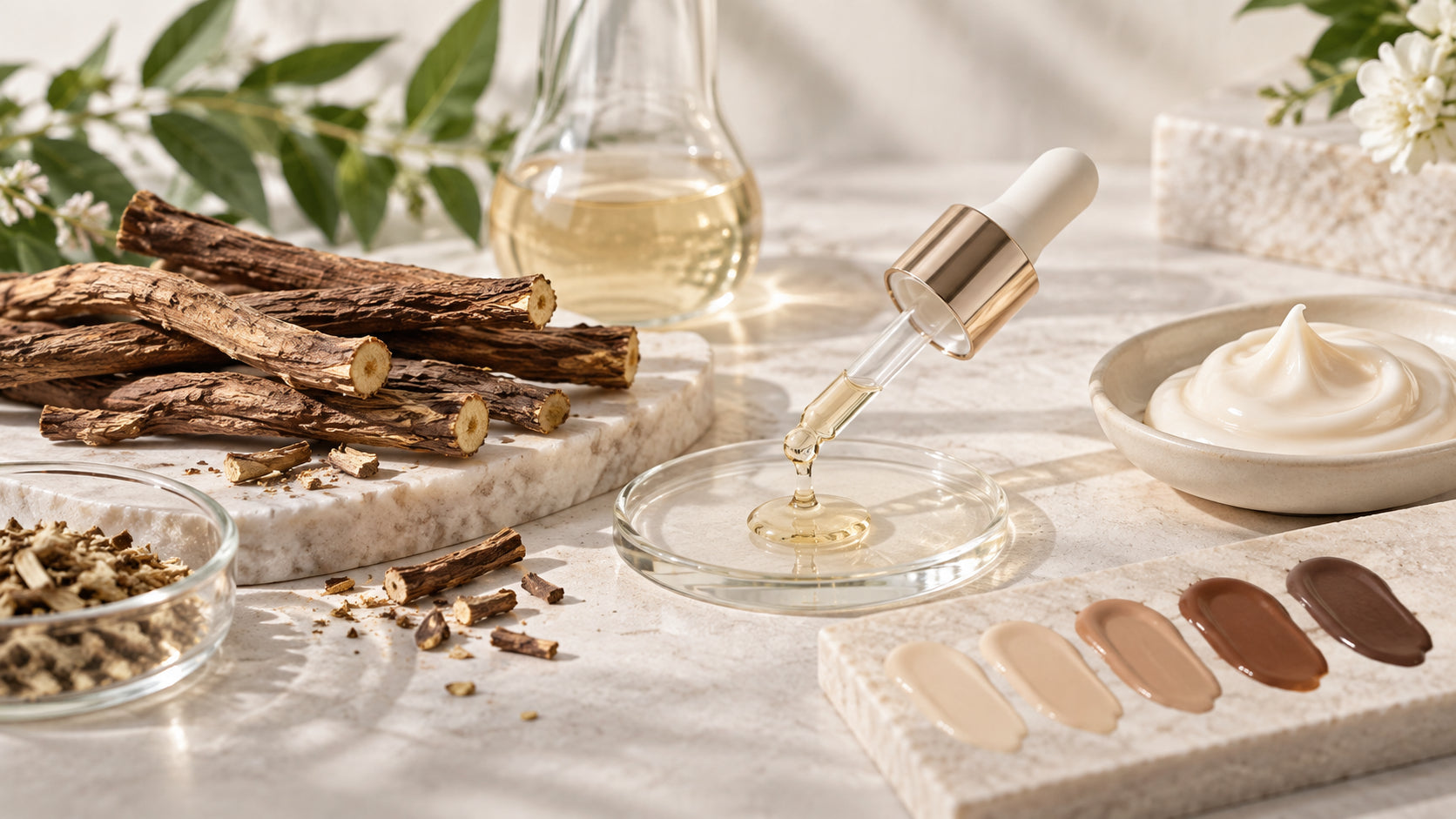
Licorice root is a supporting botanical option in dark-spot skincare, with evidence that varies by compound and formula. Glabridin has pigment-pathway research, and liquiritin has a small human melasma study. These findings do not prove that every licorice extract removes hyperpigmentation.
Melanin is pigment made by melanocytes, and tyrosinase participates in its production. More visible pigment can follow light exposure, inflammation or other triggers. Glabridin research examines tyrosinase-related activity, making the molecule relevant to the development of brightening formulas.
The often-cited glabridin experiment used cells and animal skin. A pathway result explains a possible mechanism; it cannot predict how far a particular human dark spot will fade. A complete hyperpigmentation assessment also considers the cause and depth of the discoloration.
A small split-face melasma trial investigated a specified liquiritin cream, alongside sun precautions. Liquiritin is different from glabridin and from a general root extract. Our human-evidence guide explains why that study cannot validate an unrelated serum or promise a result date.
“Licorice extract” can describe materials with different compositions. The extract-label guide helps distinguish species and active-compound disclosure. Evidence for the finished formula, if available, is more informative than a botanical name alone.
| What you see | What it means for a licorice step |
|---|---|
| Flat dark marks after blemishes | A pigment-focused cosmetic may fit, while the source of new inflammation still needs attention. |
| Red or purple residual marks | Vascular redness and pigment are different targets; pigment research is not proof of clearing these marks. |
| Patchy or recurrent melasma | Professional assessment may be needed; an ordinary botanical serum is an optional cosmetic, not a substitute for a treatment plan. |
| Raised, indented or changing spots | Texture changes and suspicious lesions need a different assessment. |
For blemish-related discoloration, read the post-acne marks guide. A new, irregular, rapidly changing, bleeding or symptomatic spot deserves medical assessment before experimenting with brightening products.
For pigment concerns, a suitable tinted sunscreen with iron oxides can also help address visible-light exposure. See sunscreen for dark spots and tinted versus untinted sunscreen. Licorice antioxidant or UV-model research does not establish SPF.
PIH can occur across skin tones, and irritation can contribute to new discoloration. There is no reason to assign someone a stronger formula solely from their complexion. If a new product stings persistently or produces a rash, stop it. A comfortable routine and control of ongoing triggers are more useful than chasing the largest ingredient percentage.
By Herbal Dynamics Beauty · Reviewed October 6, 2026.