Your Cart is Empty
Quick answer: L-ascorbic acid is the biologically active and best-studied topical form of vitamin C, but it is unstable and usually requires an acidic formula. Derivatives are modified for properties such as stability or tolerability; they are not interchangeable, and clinical evidence varies by ingredient.
| Form | Key advantage | Main limitation |
|---|---|---|
| L-ascorbic acid | Most directly studied; active form | Oxidation-prone, acidic formulas may sting |
| 3-O-ethyl ascorbic acid | Designed for improved stability and used in water-based formulas | Smaller clinical evidence base than L-ascorbic acid |
| Sodium ascorbyl phosphate | Often used in gentler, less acidic formulas | Must be evaluated on its own evidence, not assumed equal to L-ascorbic acid |
| Magnesium ascorbyl phosphate | Water-soluble derivative used in cosmetic brightening formulas | Conversion and penetration depend on formulation |
| Tetrahexyldecyl ascorbate | Oil-soluble and compatible with anhydrous formulas | Independent clinical data are comparatively limited |
L-ascorbic acid readily oxidizes in water and is typically formulated below pH 3.5 to aid skin penetration. Light, air, heat and time can accelerate change. Antioxidant partners and appropriate packaging may improve stability, but no packaging makes an unstable formula permanent.
A chemical modification can change solubility, stability and how an ingredient behaves in a cosmetic base. Some derivatives must be converted in skin; others may have activity of their own. “Vitamin C derivative” is therefore a category, not a single evidence rating.
For the derivative used in Herbal Dynamics Beauty’s serum, read our 3-O-ethyl ascorbic acid evidence guide.
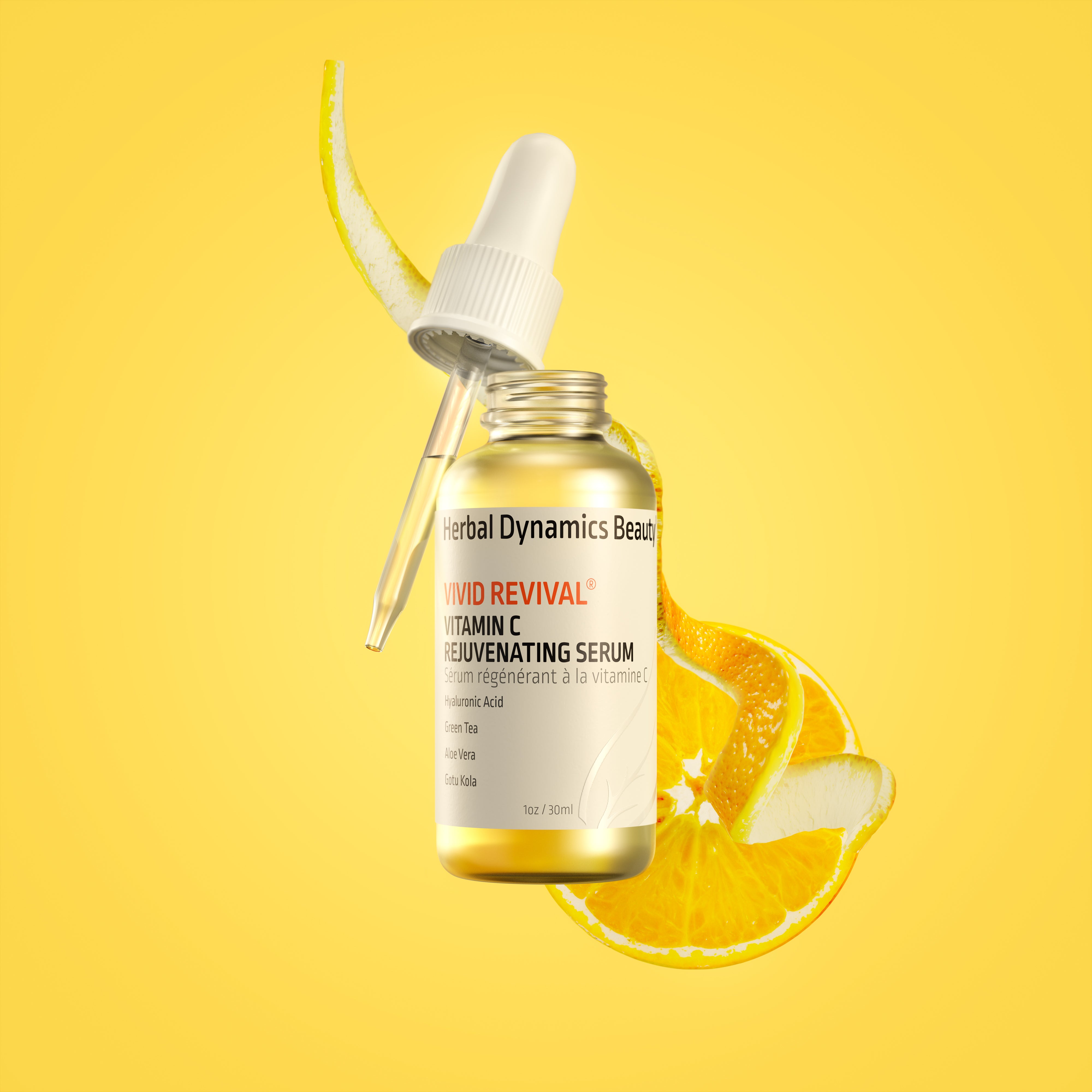
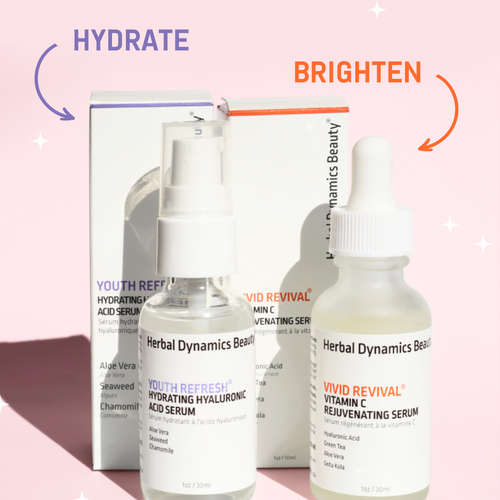
Vivid Revival® Vitamin C Rejuvenating Serum uses ethyl ascorbic acid rather than L-ascorbic acid, in a hydrating formula with hyaluronic acid, aloe and glycerin. That distinction is important: it should be evaluated as a derivative formula and not compared to L-ascorbic acid by percentage alone.