Your Cart is Empty

Short answer: Topical vitamin C can support antioxidant care and may modestly improve uneven pigmentation and some signs of photoaging when it is delivered in a stable, well-tolerated formula. The strongest clinical history belongs to L-ascorbic acid, while vitamin C derivatives vary in how well they have been studied. A vitamin C serum complements sunscreen; it does not replace it.
This guide explains the ingredient names, evidence, stability, concentrations, pairings, and safety details that matter more than marketing superlatives.
| Ingredient family | Vitamin C and topical vitamin C derivatives |
|---|---|
| Reference INCI name | Ascorbic Acid (L-ascorbic acid) |
| Common derivative INCI names | 3-O-Ethyl Ascorbic Acid, Sodium Ascorbyl Phosphate, Magnesium Ascorbyl Phosphate, Ascorbyl Glucoside, Tetrahexyldecyl Ascorbate |
| Classification | Antioxidant and skin-conditioning ingredient; formulation-dependent brightening and photoaging support |
| Natural or synthetic? | Vitamin C occurs naturally in foods and the body, while cosmetic ascorbic acid and its derivatives are manufactured and formulated for stability. A fruit image on the label does not establish the source or performance of the active. |
| AM or PM? | Either; morning use is common because it can complement—but never replace—sun protection |
| Claim | Evidence assessment | Realistic interpretation |
|---|---|---|
| Supports antioxidant protection | Supported for suitable formulas | Vitamin C can neutralize reactive species in experimental and human-skin research, but performance depends on delivery and stability. |
| Improves uneven pigmentation | Moderate | Systematic reviews and controlled studies report benefit for some pigmentation outcomes, but response varies and sunscreen remains essential. |
| Improves fine lines and photoaged texture | Promising to moderate | Some clinical trials report improvement over months; reviews still call for larger, better standardized studies. |
| Supports collagen synthesis | Biologically plausible with some clinical support | Vitamin C is involved in collagen biology, but a serum should not promise to rebuild all lost collagen or erase deep wrinkles. |
| Acts as sunscreen | False | Vitamin C is not an approved UV filter and does not provide a labeled SPF. It must not replace broad-spectrum sunscreen. |
| Treats disease or heals sunburn | Not an appropriate cosmetic claim | A cosmetic serum is not treatment for skin cancer, melasma, inflammatory disease, or an acute burn. |
L-ascorbic acid is the biologically active reference form and has the longest clinical history in topical photoaging research. It is also difficult to formulate: it oxidizes in water, and skin delivery depends on concentration, pH, vehicle, packaging, and storage.
Vitamin C derivatives are modified for goals such as improved stability, solubility, or tolerability. They must be delivered to skin and, for many proposed effects, converted or otherwise act in the tissue. A derivative being more stable in a bottle does not prove that it produces the same clinical result as L-ascorbic acid.
For example, 3-O-ethyl ascorbic acid is a more stable derivative used in cosmetics, but there is no universal basis for claiming that 80% of every topical dose converts to ascorbic acid in human skin. Evidence belongs to the specific ingredient, vehicle, concentration, and study—not to the words “vitamin C” alone.
Read the INCI list. “Vitamin C complex” or “fruit vitamin C” does not tell you which active form is present. Match claims to research on the listed form.
Light, oxygen, water, heat, and formula pH can affect stability. Opaque or tinted, well-sealed packaging is generally more protective than a clear, frequently opened jar. Airless packaging can help, but no package rescues a poorly designed formula.
Higher is not automatically better. L-ascorbic acid products are commonly sold in a range of concentrations, but a large front-label number may refer to a derivative, blend, or raw-material solution. Irritation risk can rise with an acidic, high-strength formula, while a stable lower-strength product may be more usable.
Storage guidance, shelf life after opening, and expected color vary. A product that becomes markedly darker, develops a new odor, or changes texture may be oxidizing or destabilizing; follow the manufacturer’s replacement guidance rather than a universal color chart.
Consistency matters more than forcing daily use of a formula your skin cannot tolerate. Improvements in pigmentation or photoaged texture generally take weeks to months, and no timeline is guaranteed.
| Pairing | Can they be used together? | What to watch |
|---|---|---|
| Vitamin C + vitamin E + ferulic acid | Yes, when formulated together | Certain combinations can improve stability or antioxidant performance; this does not justify mixing raw ingredients at home. |
| Vitamin C + niacinamide | Generally yes | Modern finished products do not universally cancel each other out. Separate them if your specific formulas irritate or pill. See Herbal Dynamics Beauty’s niacinamide guide. |
| Vitamin C + hyaluronic acid | Yes | Hyaluronic acid adds hydration but does not make an unstable vitamin C formula effective. See Herbal Dynamics Beauty’s hyaluronic acid guide. |
| Vitamin C + retinoids | Possible | Using both at once may irritate sensitive skin. Morning/evening separation can simplify the routine. |
| Vitamin C + AHAs or BHAs | Possible | Multiple acidic products can increase stinging and barrier disruption. Alternate if needed. |
People with very reactive skin, active dermatitis, or a damaged barrier may find acidic L-ascorbic acid uncomfortable. A derivative or lower-strength formula may be easier to tolerate, but “derivative” does not guarantee gentleness. Avoid applying a cosmetic serum to broken skin or close enough to enter the eyes.
Darkening or stinging is not evidence that vitamin C is “detoxing” skin. Persistent irritation can worsen post-inflammatory discoloration, particularly in skin prone to hyperpigmentation.
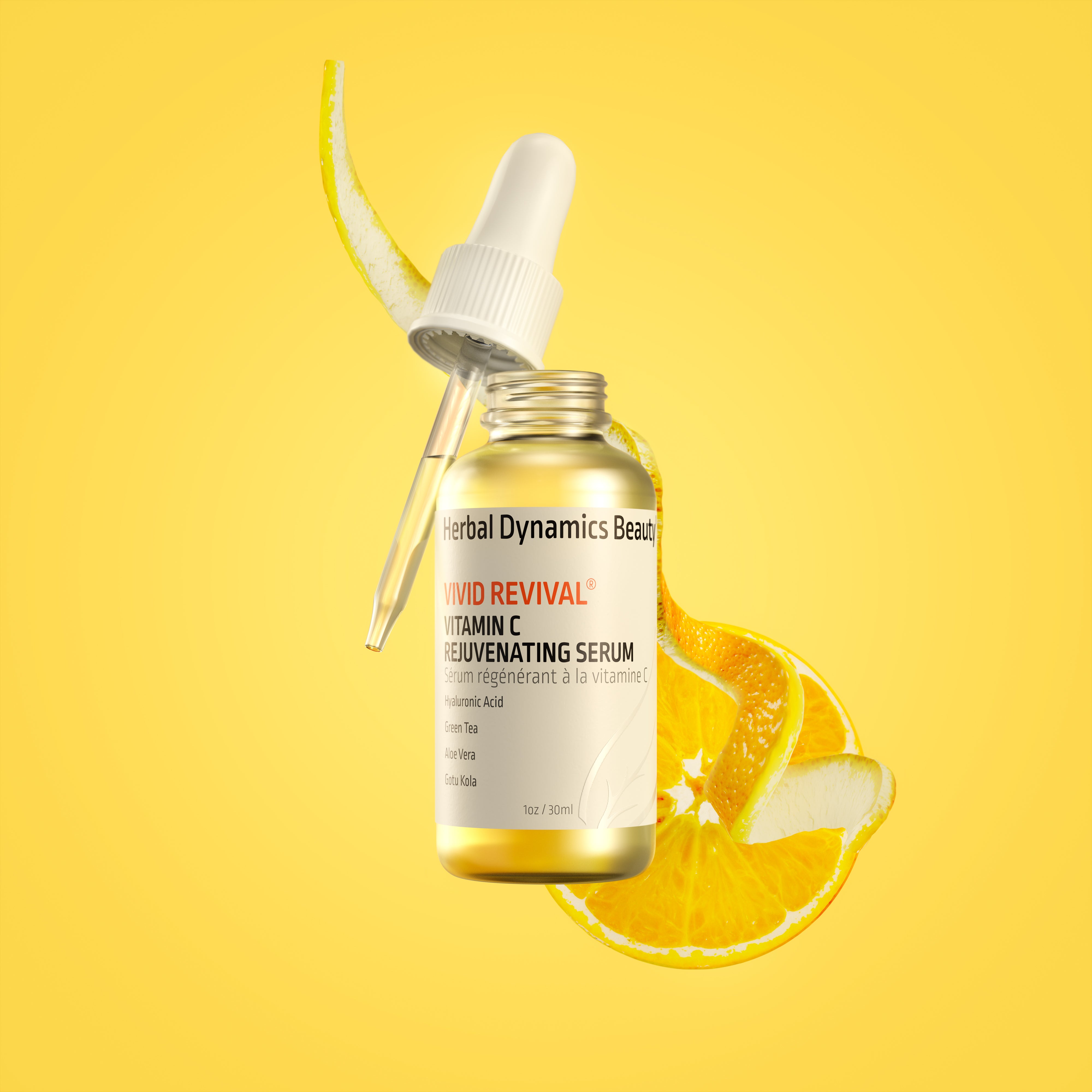
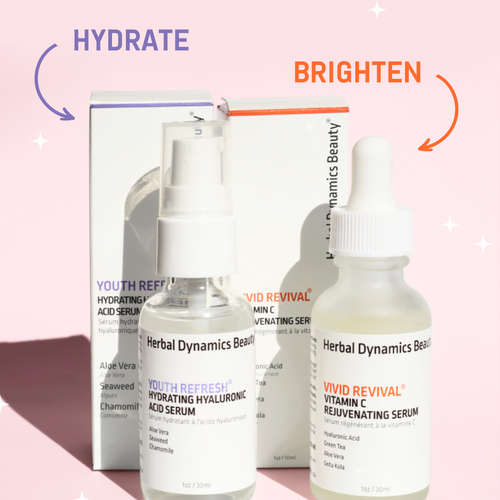
Herbal Dynamics Beauty Vivid Revival® Vitamin C Rejuvenating Serum is an active Herbal Dynamics Beauty product. Evaluate it by its exact ingredient list, packaging, directions, tolerance, and the evidence for its vitamin C form—not by the word “vitamin” or a front-label percentage alone.
Disclosure: Herbal Dynamics Beauty makes and sells this product. Its inclusion does not change the evidence standard used in this guide, and the serum does not replace sunscreen or medical treatment.
No. The form, purity, vehicle, pH, stability, and what the percentage describes all matter. A higher number can increase irritation and does not guarantee better delivery or results.
Many people use it daily, but frequency should follow the formula and your tolerance. Starting slowly is reasonable for sensitive skin.
Either can work. Morning use pairs logically with sunscreen, while evening use may fit a simpler routine. Vitamin C does not make skin sun-proof at either time.
No. Pigmentation has many causes and depths. Vitamin C may modestly improve some uneven tone, but persistent or changing pigment should be evaluated, and conditions such as melasma often need a broader plan.
A brief mild sensation can occur with acidic formulas, but pain, persistent burning, swelling, rash, or peeling is a reason to stop. Irritation is not required for benefit.
Editorial note: This article provides cosmetic skin-care education and is not medical advice. A dermatologist should evaluate persistent pigment changes, dermatitis, or any changing lesion.